April 2025 Quiz
Choose an answer under each photo to see straight away whether you are right, with a note on what to look for. Your score is at the end.
Choosing an answer shows the result at once. With a keyboard, use the arrow keys to move between answers and press Enter to choose.
-
Question 1 of 2
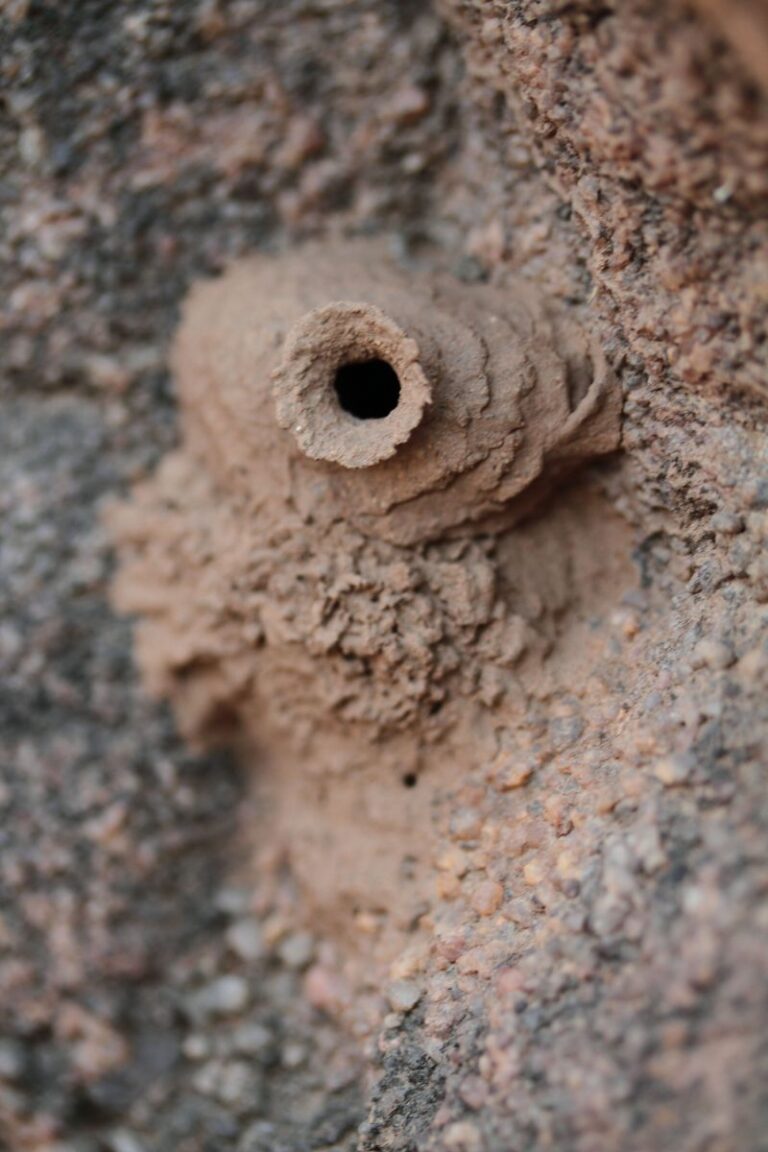
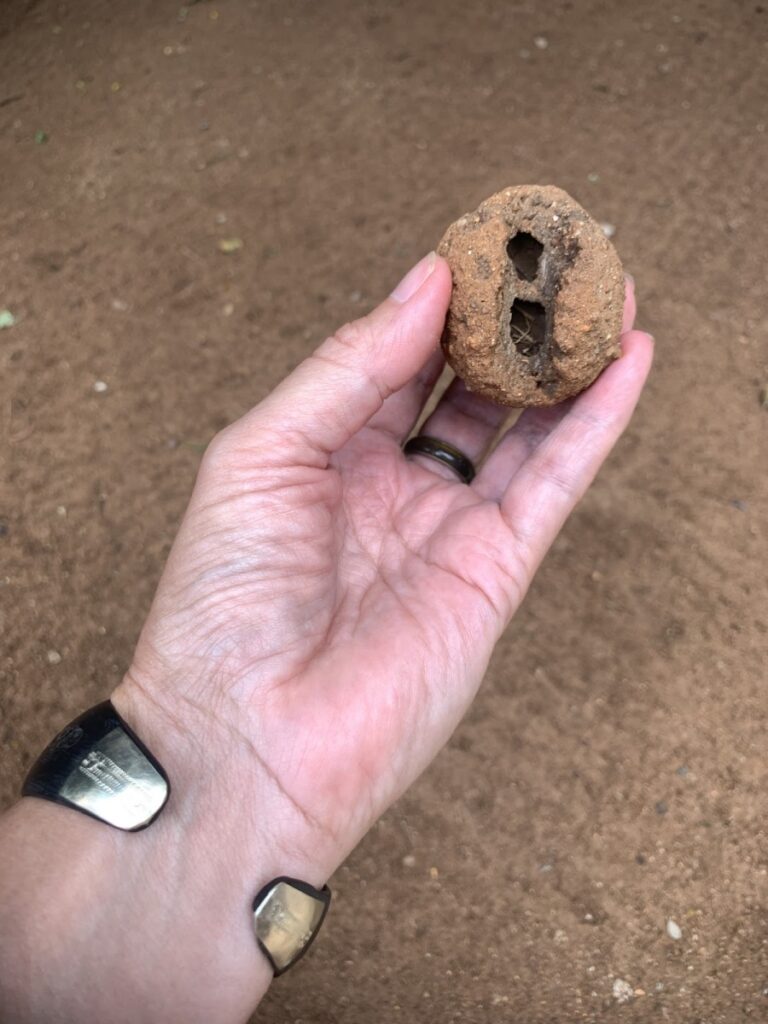
What is this? Who is responsible? Photo taken in the Greater Kruger Region of South Africa by Kersey Lawrence.
Location: central Kruger region, South Africa Photo: Kersey Lawrence This is a delta wasp nest, likely from the species Delta emarginatum. These wasps don’t actually gather mud like other “potter wasps” do. They select a soil of specific consistency, gather water, and fly back to the selected soil to add the water to it, creating their own mud. They form mud balls with their front feet, and create these large nest structures on buildings, trees, and other places. You can see where the nest fell off the branch it was attached to in the photo. You can also see some of the provisioning chambers where the wasp would have laid one egg per chamber, and provisioned her young with live caterpillars that she has paralyzed before sealing them together, inside.
Potter wasps, on the other hand, collect mud from the edges of water and fly with these little mud balls to the site where they will build their nest. Another difference seems to be that potter wasps usually provision their young with paralyzed spiders instead of caterpillars (but it is unknown if provisioning is species specific, or due to a prey species being commonly available at a particular time and place).
Reference: Invertebrates of Southern Africa and their Tracks and Signs, by Lee Gutteridge.
An interesting bit of field knowledge is that if you can identify the various types of wasps, or their nests, some species can indicate that you are near water, because they are limited in how far they can fly with their mud ball before it dries. This can be valuable information when you are on a trail, because your animal (or another one) could have gone to drink.
Photo by Kersey Lawrence, Greater Kruger region of South Africa
-

Delta wasp mud nest, signs · South Africa -
Delta wasp mud nest, Kruger region of South Africa, Kersey Lawrence · South Africa
-
-
Question 2 of 2
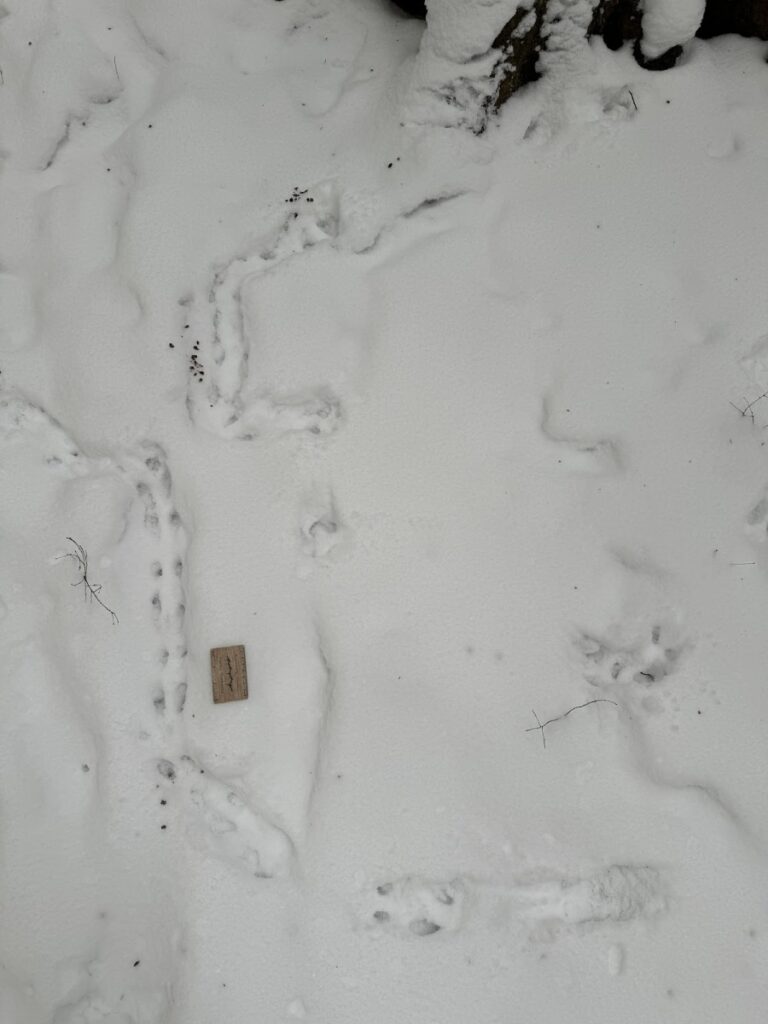
Who is responsible for this set of tracks? Photo taken by Shane Hawkins in an old growth Hemlock and White Pine forest in Northwestern Pennsylvania, USA.
Location: Pennsylvania, USA Photo: Shane Hawkins These are flying squirrel tracks. When flying squirrels are on the ground, they often move around using very short hops. In this scene, the squirrel was traveling extensively throughout the area eating hemlock cones as it went along. Both northern and southern flying squirrels are present in the area, and there is crossover in trail width, so it could be either one. However, there is research that says that southern flying squirrels are increasingly moving north, and they can host a parasite called Strongyloides robustus that can be lethal if transmitted to northerns. This ultimately results in southern flying squirrels outcompeting the northern species.
Photo by Shane Hawkins, Northwestern Pennsylvania, USA
-
Flying squirrel tracks, Northwestern PA, USA. Shane Hawkins
-
Your score
Answer every question to see your score. 2 to go.