
The Tracking Literature library gathers research on tracks and signs, trailing, and animal behaviour and ecology, together with related fields such as human tracking, forensics, ichnology and taphonomy. Behaviour and natural history papers are here even when they never mention tracking, because understanding behaviour matters to trackers.
Search every field, or narrow the list with the filters. Each paper has its own page with a synopsis, keywords and the full citation. Where a paper is open access, or the authors or publisher have given permission, you can download the PDF; otherwise the page links to the publisher or a legal free copy.
2014Publisher link
Current Trends of Wildlife Research (with an overview of research in the past and lessons for future)
Forty years ago, wildlife research in India meant reading tracks and signs and watching behaviour. Now it means satellite collars, GIS and DNA. A veteran crocodile, tiger and elephant researcher from Odisha asks that new gadgets not push aside traditional skills and jobs, and that scientists write in plain language for the field staff who use their findings.
2014Publisher link
Deception by Flexible Alarm Mimicry in an African Bird
In the Kalahari, fork-tailed drongos act as watchmen for babblers and meerkats, but when one finds a juicy meal, a drongo may shout a false alarm and steal it. This study shows that drongos mimic their targets’ own alarm calls and switch to a different call when a trick has just failed, so their victims never get used to the lie.
2014Publisher link
Foraging behaviour of a neglected pit-building predator: the wormlion
Most people know the antlion’s sandy pit trap, but wormlions, the larvae of small flies, build almost the same trap. In shady corners of Tel Aviv, researchers found that wormlion pit size says little about the size of the larva inside, and hungry wormlions surprisingly built smaller pits, not bigger ones. Crowding in the laboratory pushed pits apart and made them smaller, hinting at competition through thrown sand.
2014Publisher link
Home range characteristics of a subordinate predator: selection for refugia or hunt opportunity?
Where does a cougar choose to live when wolves are moving back in? Following 28 collared cougars over ten years near Yellowstone, researchers found that cougars picked home ranges with good hunting and kept their distance from wolf packs, but did not seek out extra forest or rugged ground. Females chose the best hunting areas, which may bring them closer to wolves after the same prey.
2014PDF available
Identification of Bald and Golden Eagle Feathers
Is that feather from a bald eagle, a golden eagle, or a dyed turkey? This U.S. Fish and Wildlife Service forensic guide shows wildlife officers how to tell, from the golden eagle’s “marbling” to the “mud-spattered” look of young bald eagle feathers. Small details, such as grooves on the shaft and a shiny layer under goose feathers, help rule out the look-alikes.
2014PDF available
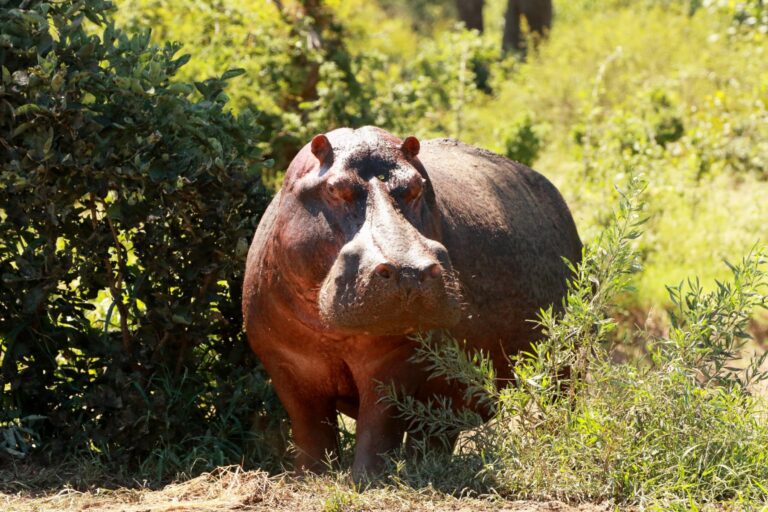
If hippopotamuses cannot swim, how did they colonize islands?
Can a hippo swim? This review argues probably not: hippos are too dense and walk along river bottoms instead. So how did they reach islands such as Cyprus, Crete and Madagascar? The author suggests land bridges or shallow crossings, and that island hippo fossils may reveal old land connections.
2014PDF available
Manifold Learning Approach to Curve Identification with Applications to Footprint Segmentation
Can a computer outline a tiger’s footprint as well as an expert? Using a Kinect depth camera and prints laid in sand at a tiger rescue centre, engineers and WildTrack’s footprint specialists built a method that traces the toes and pad automatically, landing on average within about 6 pixels of the experts’ marks. It is a step toward faster footprint identification of individual animals.
2014PDF available
Marking activity of the Kamchatka brown bear (Ursus arctos piscator)
In Kamchatka’s Valley of Geysers, brown bears leave messages for each other on stone birches: rubbed hair, bite patches, claw scratches, and a trail of deep, stamped footprints leading to the tree. Surveying 203 marked trees, this study found most on ridge-top trails, many used year after year, with marking peaking in the May to June mating season.
2014Publisher link
On tracks: A spoor-based occupancy survey of lion Panthera leo distribution in Kafue National Park, Zambia
How do you find lions in a vast park with few roads and no previous data? In northern Kafue National Park, Zambia, researchers drove dirt roads at sunrise reading lion tracks, and used occupancy modelling to estimate that lions use about 72% of the area. Habitat, not prey or distance from people, best explained where lions were, which the authors link to illegal bushmeat hunting reaching deep into the park.
2014PDF available
Puma communication behaviours: understanding functional use and variation among sex and age classes
What is a puma scrape actually saying, and who is listening? Using video cameras and hand-made scrapes in California’s Santa Cruz Mountains, researchers found that pumas spot the scrape by eye and read the message in the urine. Adult males made most scrapes to advertise themselves, while females visited less often and spent their time sniffing out potential mates.
2014PDF available
Rapid assessment of wildlife abundance: estimating animal density with track counts using body mass–day range scaling rules
How many animals live in the southern Kalahari? Using track counts by an expert local tracker and a formula that converts tracks into density, Keeping estimated numbers for 36 species, from hares and mongooses to lions and tortoises, many of which no other survey method could count. He also found that Kalahari animals travel much farther each day than body-size rules predict, and showed how to correct for it.
2014Publisher link
SAS Tracking Handbook
This handbook on the tracking skills of the British SAS sets out how armies, border agents and rescuers follow people across jungle, desert and city, and how the same skills apply to animals. From top sign and key sign to how long trodden grass stays green, this handbook is packed with practical tips and exercises for anyone learning to read tracks and signs.
2014Publisher link
Sex Determination of Amur Tigers (Panthera tigris altaica) From Footprints in Snow
Only about 20 Amur tigers are left in northeastern China, and they are hard to monitor, but they leave footprints in the snow. Researchers photographed hundreds of prints from captive tigers of known sex and built a computer model that told males from females with about 98% accuracy. Applied to 8 wild trails, it suggested 5 were made by females and 3 by males.
2014PDF available
The Next Level of Tactical Awareness: Getting Left of Bang
“Bang” is the moment something goes wrong; getting “left of bang” means reading the warning signs before it happens. In this short piece for police officers, a former Marine Corps Combat Hunter instructor explains how knowing what is normal makes the unusual stand out, a habit every tracker will recognise.
2014PDF available
The difference between killing and eating: ecological shortcomings of puma energetic models
How much does a puma really need to kill? By following GPS-collared pumas to more than 2000 clusters in Chile, Colorado and California and reading the signs at each kill, researchers found that pumas killed about 10 kg of prey a day, roughly three times what they ate. Energetic models based on body weight and activity predicted what pumas eat fairly well, but badly underestimated what they kill.
2014Publisher link
Top marks from top dogs: tandem marking and pair bond advertisement in African wild dogs
When a dominant African wild dog leaves a urine mark, their partner often marks right on top of it. Watching 13 packs in northern Botswana, researchers found that who ends up “on top” depends on whether the pair are a true breeding couple or a brother and sister who inherited the pack. Sister-led pairs kept more of their marks apart, which hints that their scent may be a message to outside males.
2014PDF available
Tracker Mindset for Explosive Device Emplacement Indicator Detection
Can a tracker’s way of seeing help Soldiers spot where a bomb was buried? United States Army researchers gave 28 Soldiers a two-day course in reading human tracks and signs in a sand pit, and their scores on knowledge, photo and spoor pit tests all improved. The Soldiers’ feedback was clear: they wanted more time in the dirt.
2014PDF available
Tracks in snow and population size estimation: the wolf Canis lupus in Finland
Can counting wolf tracks crossing ski trails tell you how many wolves a country has? Finland compared 20 years of a nationwide winter snow track census with yearly counts of wolf litters and found that the tracks picked up the population’s five-fold rise and later fall, even with fewer than one wolf per 1000 km². The authors also used tracks and daily travel distance to estimate wolf numbers, but caution that wolf tracks are too few to count the population reliably year by year.
2014PDF available
Uniting Statistical and Individual-Based Approaches for Animal Movement Modelling
Can a computer model predict how caribou will move when a forest changes? Using GPS data from 27 woodland caribou in Québec, researchers built a model that accounts for hunger and memory. When simulated logging turned forest to deciduous stands, the virtual caribou changed their habitat choices in ways that could bring them closer to wolves.
2014PDF available
Using Artificial Passageways to Facilitate the Movement of Wildlife on Namibian Farmland
Can an old car tyre help a cheetah get home? On a Namibian wildlife farm, 49 scrap tyres set into a game fence became passageways for at least 18 mammal species, from jackals and porcupines to resident cheetahs and a leopard. A trail camera and an experienced San tracker reading spoor at the tyres showed who was crossing, and the tyres halved daily fence repairs for just USD 252.
About the library
What is the Tracking Literature library?
A searchable collection of research papers on tracks and signs, trailing, and animal behaviour and ecology, gathered by Original Wisdom. Each paper has its own page with a plain-language summary, keywords, the full citation and a link to the paper.
Can I download the papers?
Where a paper is open access, or the authors or publisher have given permission, you can download the PDF from its page. Otherwise the page links to the publisher or to a legal free copy.
Who writes the summaries?
Kersey Lawrence of Original Wisdom summarises each paper: what the researchers did, found and concluded, how tracking was used, who did the tracking, and what it means for trackers.
How do I find papers on one species or place?
Type it in the search box, which searches every field including scientific names, or tick it in the Species or Region filter. Filters combine, so you can narrow the list to, for example, leopard papers from Botswana.
How should I cite a paper or a summary?
Each paper page gives the full citation and DOI of the original paper, and a ready-made citation for Original Wisdom's summary of it.