
The Tracking Literature library gathers research on tracks and signs, trailing, and animal behaviour and ecology, together with related fields such as human tracking, forensics, ichnology and taphonomy. Behaviour and natural history papers are here even when they never mention tracking, because understanding behaviour matters to trackers.
Search every field, or narrow the list with the filters. Each paper has its own page with a synopsis, keywords and the full citation. Where a paper is open access, or the authors or publisher have given permission, you can download the PDF; otherwise the page links to the publisher or a legal free copy.
1987PDF available
A Possible Method for Estimating River Otter, Lutra canadensis, Populations Using Snow Tracks
How do you count an animal that spends most of its life underwater? In the snowy boreal forest of northern Alberta, researchers walked 500 m stretches of frozen shoreline, counting fresh River Otter tracks, ageing them by hoarfrost, and following trails to avoid counting the same otters twice. The result was an estimate of 44 otters along 250 km of shoreline, and a frank look at what it takes to make track counts precise.
1987PDF available
Seasonal Marking in an Otter Population
For three years, two researchers walked the same nine kilometres of a Welsh river every month and counted every otter sign they found. Otter marking surged each winter and early spring, with more droppings, jellies, scratching and rolling, and big flattened “signal sites” on open banks. The authors link this to young otters leaving their mothers and the adults sorting out who is dominant.
1987Publisher link
The Mechanics of Horse Legs
Why can a horse gallop at nearly 70 km/hr and keep going for many kilometres? Milton Hildebrand’s classic review shows how horse legs work as levers, springs, pendulums and cushions, from the ligaments that lock the legs at rest to the transverse gallop and narrow track that shape the footprints they leave.
1987Publisher link
The Use of Spraints for Surveying Otter Lutra lutra Populations: An Evaluation
Can otter droppings tell you where otters live and how well they are doing? Responding to a study that doubted it, two otter researchers tested the standard spraint survey with data from Wales, Spain, Greece, North Africa and beyond. They found the method maps otters reliably, gives a broad guide to population health, and shows that bankside cover matters, as long as surveys avoid floods and allow for the season.
1987PDF available
Use of Radio Tracking to Improve the Estimation by Track Counts of the Relative Abundance of Red Fox
How many foxes does a line of tracks in the sand really represent? By radio tracking red foxes in Spain’s Doñana reserve, researchers found that each fox crossed a fence transect up to six times a night, and that simply moving the transect could change the count. Their short study shows how knowing animals’ movements can turn track counts into better estimates of abundance.
1986Publisher link
Use of Road Track Counts as Indices of Mountain Lion Presence
Could you prove mountain lions are living in an area just by driving its dirt roads and looking for tracks? In Arizona and Utah, researchers tested road track searches against lions they already knew were there from radio collars. Over 14 months the searches found every resident lion, and good dirt roads beat fresh snow for finding them.
1985Publisher link
A Comparison of Methods Used to Examine Snowshoe Hare Habitat Use
Do hare tracks in the snow tell the same story as their droppings, or as live traps? Over two winters in Maine, researchers compared all three and found that each pointed snowshoe hares to dense understory. Snow track counts proved a cheap way to cover large areas, though tracks show where hares travel more than where they linger.
1985Publisher link
Counter-insurgency in Rhodesia
In the 1960s, Rhodesian forces met insurgents crossing the empty Zambezi valley with “track and kill” operations. By 1972 the insurgents had learned to live among local people, and a commander complained: “No tracks … no information.” The opening chapter of this military history shows how the war changed once both the tracks and the local information dried up.
1985PDF available
Design and Analysis of Mountain Lion Track Surveys
How do you count mountain lions you almost never see? In 1985 two California researchers set out a step-by-step method for surveying lion tracks on dusty back roads by motorcycle, from catching the low morning sun to tracing prints on plate glass. Their own survey missed all five radio-collared lions known to be nearby, which shows why they urged caution in reading too much into track counts.
1985Publisher link
Energy of the Oscillating Legs of a Fast-moving Cheetah, Pronghorn, Jackrabbit, and Elephant
Why does a cheetah give up after a short sprint while an impala runs on? By turning films of a cheetah, pronghorn, jackrabbit and elephant at full speed into energy models of their swinging legs, the authors found that the cat’s legs carry far more energy than the pronghorn’s, even after adjusting for timing, weight and leg length. They suggest this may help explain why dash-hunting carnivores have less staying power than their hoofed prey.
1985PDF available
Pugmarks and the biology of the Bobcat, Lynx rufus
Can you follow a single bobcat family by their footprints alone? In the sandy scrub of central Florida, one observer traced the pugmarks of a mother bobcat, her two cubs and her mate, walking over 1,600 km in 15 months. Her tracks and signs reveal how the cubs were raised and split the home range between them, and how the pair kept company through the breeding season.
1985Publisher link
Selection of Sites for Winter Night Beds by White-tailed Deer in a Hemlock-Northern Hardwood Forest
Where does a white-tailed deer choose to sleep on a freezing winter night? By wiping out old beds every evening and searching the snow at sunrise, researchers in Maryland found 140 fresh night beds and compared them with random spots. Deer favoured dense hemlock overhead and on the windward side, a tree close by, and an open view to the southeast.
1985Publisher link
The efficiency of yarding behaviour by white-tailed deer as an antipredator strategy
Why do white-tailed deer crowd together in winter yards? By counting tracks in the snow and following coyote trails through two Quebec winters, researchers found that coyote pairs and packs hunted where deer were few. Most kills happened where only about 12% of the deer wintered, far from the dense web of deer trails that offered a quick escape.
1984PDF available
Aspects of the Ecology and the Behaviour of the Leopard Panthera pardus in the Kalahari Desert
What does a leopard do all night in the Kalahari Desert? By following leopard tracks through the sand for more than 1000 km, trackers and researchers recorded every stalk, chase, kill and rest. They found leopards that often simply met their prey and killed it without stalking, travelled up to 33 km in a day, and could go days without drinking.
1984PDF available
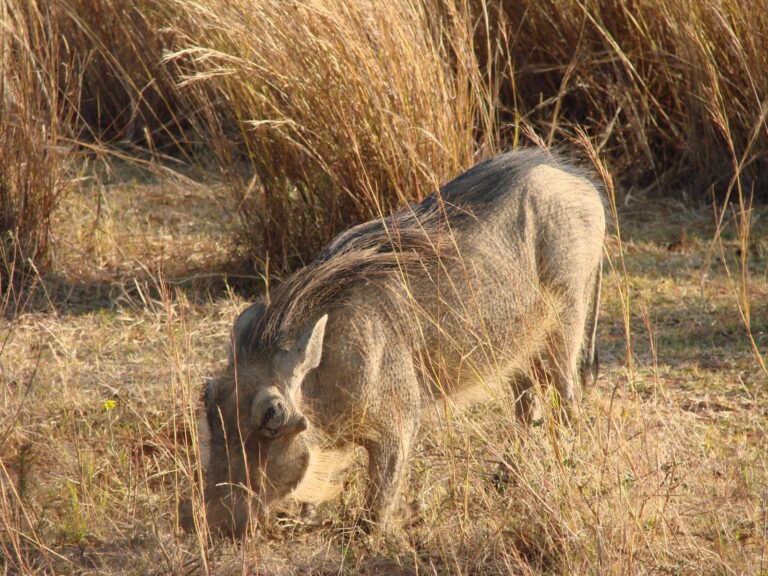
Dentition and Age Determination of the Warthog Phacochoerus aethiopicus in Zululand, South Africa
How old is that warthog? Working with hundreds of skulls from Zululand, this study shows how baby teeth, giant third molars, yearly growth rings in the teeth and the length of the tusks reveal a warthog’s age. It also gives simple field guides: juveniles, yearlings and older animals can be told apart all year by size, tusks and warts, and wild warthogs may live to about 17 years.
1984Publisher link
Differentiating Mountain Lion and Bobcat Scats
Can you tell a mountain lion scat from a bobcat scat by looking at it? In this 1984 blind test, known scats from captive cats were hidden among field-collected ones: visual identification was right for 88% of mountain lion and 64% of bobcat scats, and a bile acid test did no better on its own. When eye and chemistry agreed, there were no mistakes.
1984Publisher link
Standardised Terminology for the Description and Analysis of Equine Locomotion
Is a “step” the distance between two prints of the same foot, or half that? In 1984, three veterinary anatomists found that horse researchers could not agree, and set out a standard vocabulary for describing how horses move. Their paper explains stance and swing, overlap, line of motion, and why a horse moving “straight” actually leaves two tracks, not one.
1984Publisher link
The Relationship between White-Tailed Deer Track Counts and Pellet-Group Surveys
Can you count deer by counting their tracks across a dirt road? For ten years, Minnesota biologists dragged forest roads smooth each summer and counted the deer tracks that crossed them the next day. The counts rose and fell with spring dung surveys, but varied so much that the authors found more roads, not more repeat counts, was the way to make them reliable.
1984PDF available
The comparative behavioural ecology of the brown hyaena Hyaena brunnea and the spotted hyaena Crocuta crocuta in the southern Kalahari
Two hyaenas share the southern Kalahari, but they live very different lives. Following them through the night, the author found that brown hyaenas forage alone for scraps, fruit and insects and leave scent paste all over their territories, while spotted hyaenas hunt young gemsbok and wildebeest and live in larger, noisier clans. This comparison shows how diet shapes everything from territory size to how cubs are fed.
1983Publisher link
A guide for differentiating mammalian carnivore taxa responsible for gnaw damage to herbivore limb bones
Can you tell who ate a carcass from the bones alone? By feeding cattle bones to captive wolves, bears, hyenas and big cats, and following carcasses in the wild, Gary Haynes described the gnaw marks each group leaves: hyenas crush and splinter, bears grind bone flat, and big cats bite roughly through the ends. He then used these signs to read which carnivores fed on Ice Age bison in Alaska and the Yukon.
About the library
What is the Tracking Literature library?
A searchable collection of research papers on tracks and signs, trailing, and animal behaviour and ecology, gathered by Original Wisdom. Each paper has its own page with a plain-language summary, keywords, the full citation and a link to the paper.
Can I download the papers?
Where a paper is open access, or the authors or publisher have given permission, you can download the PDF from its page. Otherwise the page links to the publisher or to a legal free copy.
Who writes the summaries?
Kersey Lawrence of Original Wisdom summarises each paper: what the researchers did, found and concluded, how tracking was used, who did the tracking, and what it means for trackers.
How do I find papers on one species or place?
Type it in the search box, which searches every field including scientific names, or tick it in the Species or Region filter. Filters combine, so you can narrow the list to, for example, leopard papers from Botswana.
How should I cite a paper or a summary?
Each paper page gives the full citation and DOI of the original paper, and a ready-made citation for Original Wisdom's summary of it.